It is a land where history is intertwined with mysteries, myths and legends. Even its name is shrouded in mystery.
In the opinion of many, it derives from Cominio, the city destroyed in the year 293 B.C. together with Aquilonia, in the last desperate and bloody battle fought by the Samnites against the growing power of Rome, as narrated by Titus Livius and by Dionysius of Halicarnassus.
Others derive it from the Comini, one of the four peoples of the Equicoli, also proud adversaries of the Romans and defeated by them or by “cominia”, a quality of olive, both taken from Pliny the Elder's monumental work.
The toponym, which had disappeared for more than seven centuries, reappears in an act from the archives of the Benedictine Abbey of S. Vincenzo al Volturno dating back to 778 A.D., by which the Duke of Spoleto, Ildebrando, donated to it the churches of S. Donato and S. Giuliano, located “in Cumin territory”.
DE SANCTO DONATO
Hildebrandus Spoleti Dux Ecclesias S. Donati,
et S. Juliani in Cumino territory cum
terris et montibus donat Monasterio
S. Vincentii ad Vulturnum
Year DCCLXXVIII
In later documents, the name Cominio indicates a territory or a county, sometimes restricted and sometimes enlarged to include even Atina, but whose core was the area between Vicalvi, Alvito, Gallinaro, S. Donato V.C. and Settefrati.
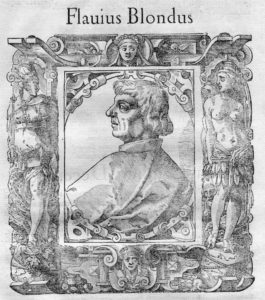
Flavio Biondo
In the mid-15th century, Flavio Biondo in his work, writes of “It is surrounded by very high mountains and has eight well-populated castles, Vicaglio, Alvito, S. Donato, Sette frati, Picinisco, Gallinaro and Casalviero: this district was called Cominio by the ancients, from a city that was so called, of which the people of the area do not know where it was, and of which Livy makes mention. In that same district on the right hand under the mountains is Atina, a very ancient city, on the side of which flows the river Melfa, which has its source in the Apennines, and goes to mix with the Garigliano near Pontecorvo: Vergilius mentions this city, and Livy himself”.
A century later, also one of the most important geographers of the time, Leandro Alberti writes about “a pleasant and fertile region”, comprising “eight castles”, and, like Biondo, accorded a certain distinction to Atina, located in the western part of the same area.
In the next two centuries (17th and 18th), during the domination of the Gallio family, the terms Duchy of Alvito and Cominese coincided, at least in popular vernacular and literature, although Casalvieri and Casalattico did not belong to that political unit, while it included Belmonte Castello, located immediately outside the valley basin.
The 19th Century
At the beginning of the 19th century, it first appeared as the toponym of a “valley” whose scope was limited to the villages on the north-eastern side and, in 1862, the municipality of S. Donato, in order to distinguish itself from others with the same name, obtained from King Victor Emmanuel II the right to add the attribute of “Val di Comino”.”.
Even in the early 1900s, according to a local historian, for Comino Valley meant only the north-eastern area, i.e. the area between Settefrati, S. Donato (with Gallinaro, then its hamlet), Alvito and Vicalvi.
Not even the generous attempt of a great geographer, Roberto Almagià, helped to give it a name. Therefore, even today, its name does not appear on official maps. So officially it does not exist, but in fact it does.
Riccardi Orazio Paolo